|
News Detail
What are the types of bearings? What does the model represent?Issuing time:2023-12-06 12:01Author:PPH BearingSource:PPH Bearing There are many types of bearings, but what are the specific ones? Today, PPH bearings will take you to learn about:
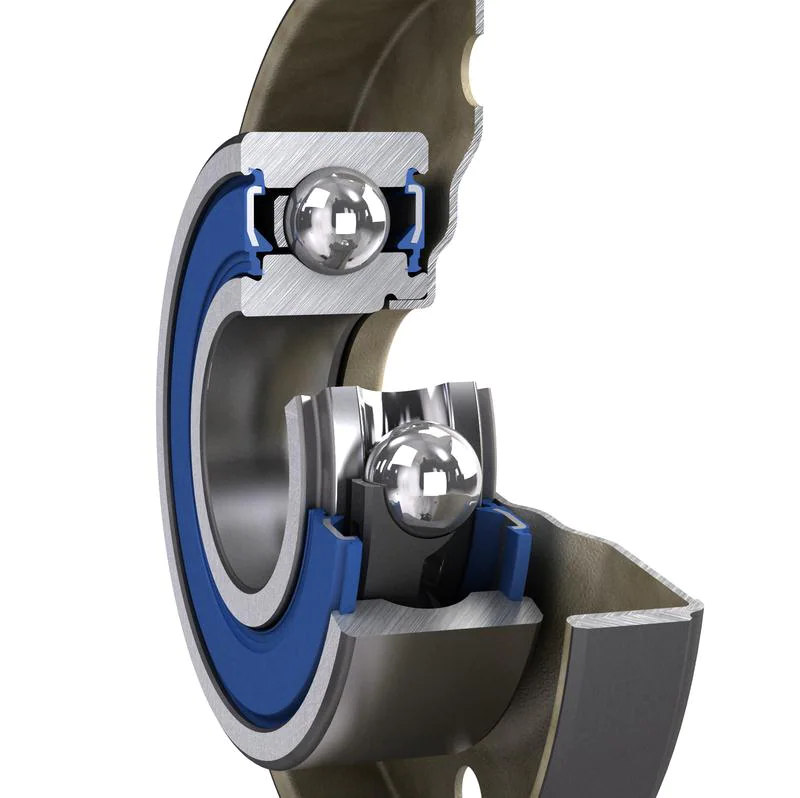
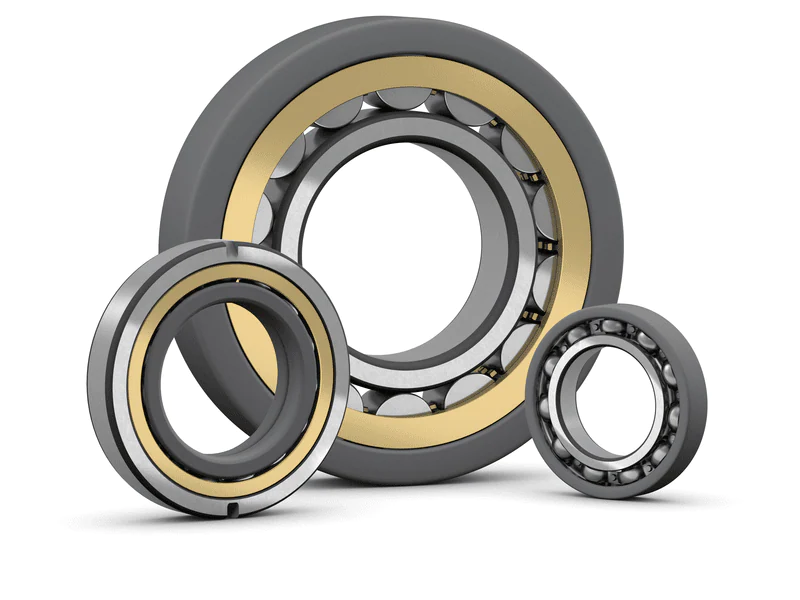
Rolling bearing: A bearing that performs rolling motion between supporting loads and parts that move relative to each other. It includes parts with raceways and rolling element groups with or without isolation or guidance. Can be used to withstand radial, axial, or combined radial and axial loads. Angular contact bearing: a rolling bearing with a nominal contact angle between the ball and the ring greater than 0 ° but less than 90 °. Outer spherical bearing: a radial rolling bearing with an outer spherical surface and a wide inner ring with locking components. Mainly used for simple shells. Linear motion bearing: a rolling bearing in which two raceways have relative linear motion in the rolling direction. Ball bearing: The rolling element is a ball rolling bearing. Deep groove ball bearing: a radial ball bearing with a continuous groove raceway with a cross-section of approximately one-third of the circumference of the ball in each ring. Thrust ball bearing: The rolling element is a ball thrust rolling bearing. Roller bearing: The rolling element is a rolling bearing with rollers. Cylindrical roller bearing: The rolling element is a radial rolling bearing with cylindrical rollers. Conical roller bearing: The rolling element is a radial rolling bearing with tapered rollers. Needle roller bearing: The rolling element is a centripetal rolling bearing for needle rollers. Spherical roller bearing: A self-aligning radial roller bearing with convex or concave rolling elements. A bearing with convex spherical rollers, with a spherical raceway on the outer ring; A bearing with concave rollers has a spherical raceway on its inner ring. Airline bearings Thrust roller bearing: The rolling element is a thrust rolling bearing with rollers. Thrust cylindrical roller bearing: The rolling element is a cylindrical roller thrust rolling bearing. Thrust tapered roller bearing: The rolling element is a thrust rolling bearing with tapered rollers. Thrust needle roller bearing: The rolling element is a needle roller thrust rolling bearing. Thrust spherical roller bearing: A self-aligning thrust rolling bearing with convex or concave rolling elements. The raceway of the bearing seat ring with convex spherical rollers is spherical, and the raceway of the bearing shaft ring with concave spherical rollers is spherical. Seat bearing: A component that combines a radial bearing and a seat, with a bottom plate for mounting screws on a support surface parallel to the bearing axis. Joint bearing: The sliding contact surface is spherical, mainly suitable for spherical sliding bearings for swinging, tilting, and rotating movements. Combination bearing: a rolling bearing composed of two or more types of bearing structures simultaneously inside a set of bearings. Such as needle roller and thrust cylindrical roller combination bearings, needle roller and thrust ball combination bearings, needle roller and angular contact ball combination bearings, etc. PPH bearings Other bearings: Rolling bearings with structures other than those mentioned above.
Below, PPH bearings will introduce you to the bearing codes: 1. Basic code for imported bearings The A basic code is used to indicate the inner diameter, diameter series, width series, and type of the bearing, usually up to five digits. It is described as follows: 1) The inner diameter of the bearing is represented by the first H-digit from the right of the basic code. For bearings with commonly used inner diameters of d=20-480mm, the inner diameter is generally a multiple of 5. These two digits represent the quotient obtained by dividing the bearing inner diameter size by 5, such as 04 representing d=20mm; 12 represents d=60mm, etc. For bearings with inner diameters of 10mm, 12mm, 15mm, and 17mm, the inner diameter codes are 00, 01, 02, and 03, respectively. For bearings with an inner diameter less than 10mm and greater than 500mm, there are other regulations for the representation of the inner diameter, which can be referred to in GB/T272-93. 2) The diameter series of bearings (i.e. the series of changes in outer diameter and width of bearings with the same structure and inner diameter) is represented by the third digit from the right of the basic code. For example, for radial bearings and radial thrust bearings, 0 and 1 represent the ultra light series; 2 represents the light series; 3 represents the middle series; 4 represents the heavy series. The size comparison between each series is shown in the following figure. The thrust bearing is represented in the same way as the radial bearing, except for using 1 to indicate the ultra light series. Longben bearings 3) The width series of bearings (i.e. the series of changes in the width of bearings with the same structure, inner diameter, and diameter) is represented by the fourth digit from the right of the basic code. When the comparison column of the diameter series in Figure 13-4 is the 0 series (normal series), the width series code O may not be indicated in the code for most bearings, but for self-aligning roller bearings and tapered roller bearings, the width series code 0 should be indicated. The diameter series code and width series code are collectively referred to as the size series code. 4) The bearing type code is represented by the fifth digit from the right of the basic code (letters are used for types such as cylindrical roller bearings and needle roller bearings). 2. Post code The post designation of bearings is used to represent the structure, tolerances, and special material requirements of the bearings using letters and numbers. There are many contents of post code, and below are some commonly used codes. 1) The internal structure code refers to the different internal structures of the same type of bearing, represented by letters followed by the basic code. For example, angular contact ball bearings with contact angles of 15 °, 25 °, and 40 ° are respectively represented by C, AC, and B to indicate the different internal structures. 2) The tolerance levels of bearings are divided into 6 levels: Level 2, Level 4, Level 5, Level 6, Level 6X, and Level 0, with codes/PZ and/PZ respectively, from high to low P4 '/PS,/P6,/P6X, and/PO. In the tolerance level, 6X grade is only applicable to tapered roller bearings; Level 0 is a normal level and is not indicated in the wheel bearing code.. 3) The commonly used radial clearance series of bearings are divided into 6 groups: Group 1, Group 2, Group 0, Group 3, Group 4, and Group 5, with radial clearance gradually increasing. The clearance of group O is a commonly used clearance group, which is not indicated in the bearing code. The other clearance groups are respectively represented by/CI and/in the bearing code CZ,/C3,/C4,/CS are represented. 3. Pre code The prefix of the bearing is used to indicate the components of the bearing, represented by letters. If L is used to represent the separable ring of a separable bearing; K represents the rolling elements and cage components of the bearing, etc. There are many types of rolling bearings in practical applications, and the corresponding bearing codes are also quite complex. The codes introduced above are the most basic and commonly used part of bearing codes. By familiarizing oneself with these codes, one can identify and select commonly used bearings. The detailed code method for rolling bearings can be found in GBT272-93.
Article classification:
Info.
|