|
News Detail
Different types and applications of bearingsIssuing time:2023-12-06 12:00Author:PPH BearingSource:PPH Bearing
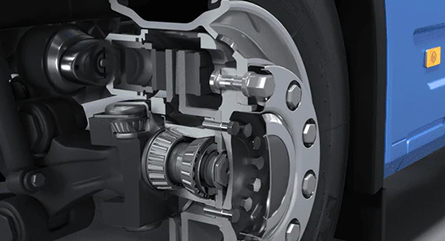
There are many types of bearings. According to the direction of the load it can withstand, it can be divided into: ① Radial bearings, also known as radial bearings, which bear radial loads. ② Thrust bearings, also known as thrust bearings, bear axial loads Radial thrust bearings, also known as radial thrust bearings, bear both radial and axial loads simultaneously. According to the different friction properties of bearings, they can be divided into two categories: sliding friction bearings (referred to as sliding bearings) and rolling friction bearings (referred to as rolling bearings). However, what are the manifestations of different types of bearings in specific application processes? Regarding this, PPH bearings have compiled some relevant knowledge for everyone. Angular contact bearing: a rolling bearing with a nominal contact angle between the ball and the ring greater than 0 ° but less than 90 °. Can withstand both radial and axial loads simultaneously. Can work at higher speeds. The larger the contact angle, the higher the axial load-bearing capacity. High precision and high-speed bearings typically have a contact angle of 15 degrees. Under the action of axial force, the contact angle will increase. Single row angular contact ball bearings can only withstand axial loads in one direction, and when subjected to radial loads, it will cause additional axial forces. And it can only limit the axial displacement of the shaft or housing in one direction. If installed in pairs, make the outer rings of a pair of bearings face each other, that is, the wide end faces the wide end faces, and the narrow end faces the narrow end faces. This can avoid causing additional axial forces and limit the shaft or housing within the axial clearance range in both directions. Outer spherical bearing: a radial rolling bearing with an outer spherical surface and a wide inner ring with locking components. Mainly used for simple shells. Linear motion bearing: a rolling bearing in which two raceways have relative linear motion in the rolling direction. Ball bearing: The rolling element is a ball rolling bearing. Deep groove ball bearing: a radial ball bearing with a continuous groove groove raceway with a cross-section of approximately one-third of the circumference of the ball, suitable for precision instruments, low-noise motors, automobiles, motorcycles, and general machinery. It is the most widely used type of bearing in the mechanical industry. The structure is simple and easy to use and maintain. It is mainly used to withstand radial loads and can also withstand certain axial loads. When the radial clearance of the bearing increases, it has the performance of an angular contact ball bearing and can withstand larger axial loads. This type of bearing has a low friction coefficient, high maximum speed, and diverse size range and form variations. Durable and sturdy, with strong versatility and low noise operation, it can run at high speeds and is easy to install. Single row deep groove ball bearings also have a sealed design, which eliminates the need for lubrication and maintenance. Single row with ball loading notch and double row ball bearings, suitable for heavy-duty working conditions. Thrust ball bearing: The rolling element is a ball thrust rolling bearing. Roller bearing: The rolling element is a rolling bearing with rollers. Cylindrical roller bearing: The rolling element is a radial rolling bearing with cylindrical rollers, which belongs to the separated type bearing and is very easy to install and disassemble. Cylindrical roller bearings are divided into single row, double row, and four row types. According to the number of rows of rolling elements installed in the bearing, cylindrical roller bearings can be divided into single row, double row, and multi row cylindrical roller bearings. One of the most commonly used is the single row cylindrical roller bearing with a cage. In addition, there are cylindrical roller bearings with other structures such as single or double row fully loaded rollers. Single row cylindrical roller bearings are classified into N type, NU type, NJ type, NF type, and NUP type according to the different ring edges. Cylindrical roller bearings have a high radial load capacity and can also withstand certain unidirectional or bidirectional axial loads depending on the structure of the ring retaining edge. NN and NNU double row cylindrical roller bearings have compact structures, strong rigidity, high load-bearing capacity, and small deformation after being loaded. They are mostly used for supporting machine tool spindles. FC, FCD, and FCDP four column cylindrical roller bearings can withstand large radial loads and are commonly used in heavy machinery such as rolling mills. Cylindrical roller bearings are mainly used in motors, machine tools, petroleum, rolling mill loading and unloading machinery, and various industrial machinery. Conical roller bearing: The rolling element is a radial rolling bearing with tapered rollers. Needle roller bearing: The rolling element is a centripetal rolling bearing for needle rollers. Spherical roller bearing: A self-aligning radial rolling bearing with convex spherical or concave rollers as the rolling elements. A bearing with convex spherical rollers, with a spherical raceway on the outer ring; A bearing with concave rollers has a spherical raceway on its inner ring. Thrust roller bearing: The rolling element is a thrust rolling bearing with rollers. Thrust cylindrical roller bearing: The rolling element is a cylindrical roller thrust rolling bearing. Thrust tapered roller bearing: The rolling element is a thrust rolling bearing with tapered rollers. Thrust needle roller bearing: The rolling element is a needle roller thrust rolling bearing. Thrust spherical roller bearing: A self-aligning thrust rolling bearing with convex or concave rolling elements. The raceway of the bearing seat ring with convex spherical rollers is spherical, and the raceway of the bearing shaft ring with concave spherical rollers is spherical. Seat bearing: A component that combines a radial bearing and a seat, with a bottom plate for mounting screws on a support surface parallel to the bearing axis. Joint bearing: The sliding contact surface is spherical, mainly suitable for spherical sliding bearings for swinging, tilting, and rotating movements. Combination bearing: a rolling bearing composed of two or more types of bearing structures simultaneously inside a set of bearings. Such as needle roller and thrust cylindrical roller combination bearings, needle roller and thrust ball combination bearings, needle roller and angular contact ball combination bearings, etc. Other bearings: Rolling bearings with structures other than those mentioned above. Sliding bearings: Sliding bearings do not have inner or outer rings nor rolling elements, and are generally made of wear-resistant materials. Commonly used for low-speed, heavy-duty, and difficult to lubricate and maintain mechanical rotating parts. Rolling mill bearings: Rolling mill bearings are generally only used to withstand radial loads. Compared with deep groove ball bearings of the same size, they have a larger radial load capacity and a maximum speed close to that of deep groove ball bearings. However, the machining requirements for the shaft and housing holes that are matched with such bearings are higher, allowing the inclination of the inner ring axis and the outer ring axis to be very small (2 ° -4 °). If the inclination of the two axes exceeds the limit, the contact between the rollers and the ring raceway will deteriorate, seriously affecting the bearing's load capacity and reducing the bearing's service life. So if this type of bearing needs to be installed in the main components that bear axial loads, it can only be used under the premise of using other types of bearings to bear axial loads at the same time. PPH bearings, looking forward to working with you.
Article classification:
Knowledge
|